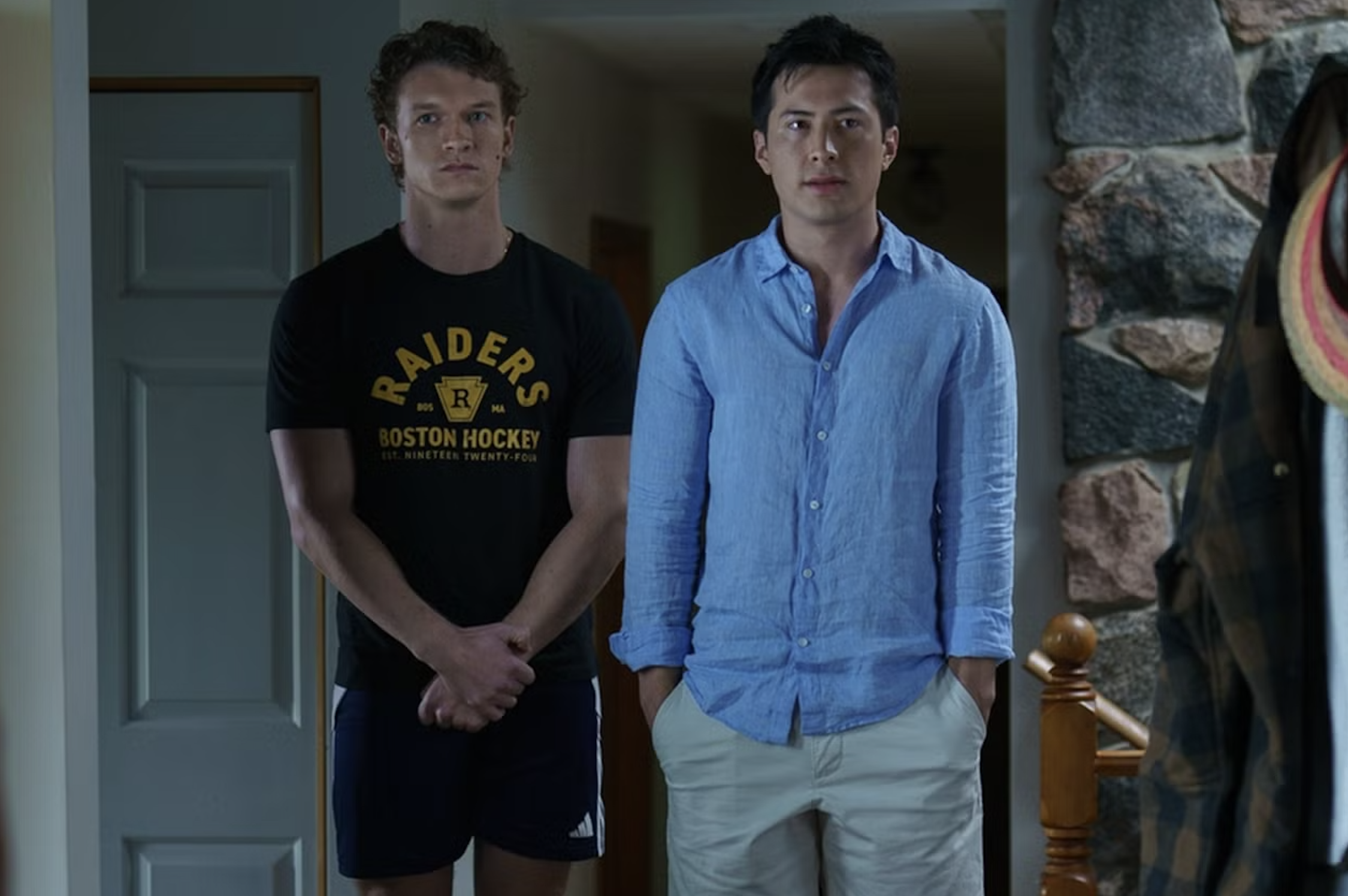
The streaming craze these days—among gay men for sure but also with people who simply appreciate a great story–is Heated Rivalry, the Canadian series about two closeted pro hockey players and their steamy, clandestine love affair.
SPOILER AHEAD
The sex scenes have not undeservedly drawn a lot of attention, but late in the six-episode first season (a second has been confirmed), the story moves beyond secret trysts to something deeper. Shane and Ilya display and express feelings of tenderness and affection beyond the pure carnality that surfaced with a bang within the first few minutes of Episode 1.
Near the end of Episode 6, at Shane’s getaway house in the Canadian countryside—Ilya’s “I’m Coming to the Cottage” has become memeworthy—the two men are discovered in a PG-rated embrace by Shane’s father, who skedaddles. Shane and Ilya go to Shane’s parents’ house, where Shane spills the beans about himself and his relationship with Ilya. Shane’s parents reveal that they had suspected their son’s homosexuality, but until now he had acknowledged it only to a couple of people.
Here’s where the story stuck a knife in me. Shane tells his mother he had tried hard to change himself but couldn’t. His mom replies, “You have nothing to apologize for.” Shane had a hard time hearing it but his mother went on. “I’m sorry I made you feel like you couldn’t tell me.”
Through my tears my childhood rushed back to me.
I was a so-called sensitive child, which I took at the time to mean I didn’t play sports, I cried freely and I had a hard time expressing my feelings. My mom would try at times to draw out of me whatever had me upset or worried, and I can see all these years later her sitting next to me on my bed. Her speech was always the same.
“I want you to know you can always talk to me. You can come to me with anything.”
And then, again always the same: “Don’t ever tell me you’re homosexual, but other than that you can always talk to me.”
It never occurred to me until decades later, when I was in my forties, the effect my mother’s words had on me. And the realization hit only with the help of a therapist. Shrinks are usually pretty stoic; they want to help patients come to their own understanding of the things that make them who they are. But this time, the therapist’s eyes bugged out.
“Your mother said that to you?”
“Yeah. A bunch of times.” The significance hadn’t hit yet.
“Clay, don’t you see the effect that could have on a child?”
In one of those slap-on-the-forehead moments that make therapy so valuable, much of the puzzle of me began to piece together. As certain feelings developed in me—in middle school P.E. class, for example—I suppressed them. More accurately, the suppression took place in a deeply subconscious way. I learned much later, again in therapy, that whether I knew it or not these internal goings-on consumed considerable emotional energy that could otherwise have been devoted to the normal struggles that occupy a teenager’s life.
How I wish that someone would have said to me what Shane’s mother said to him. My own coming-out at 21 or 22 was clumsy, conducted entirely by mail. Shane was clearly terrified when he said the words: “I’m gay.” But he had someone to let him off the hook. I didn’t, at least where my mother was concerned.
Mama is long gone so there’s nothing to work through with her. Maybe that’s why Heated Rivalry hit so hard, because it brought to the surface things I’ve preferred not to dwell on. But maybe at the same time what it’s made me feel isn’t so much regret for myself as optimism over how things can be.